
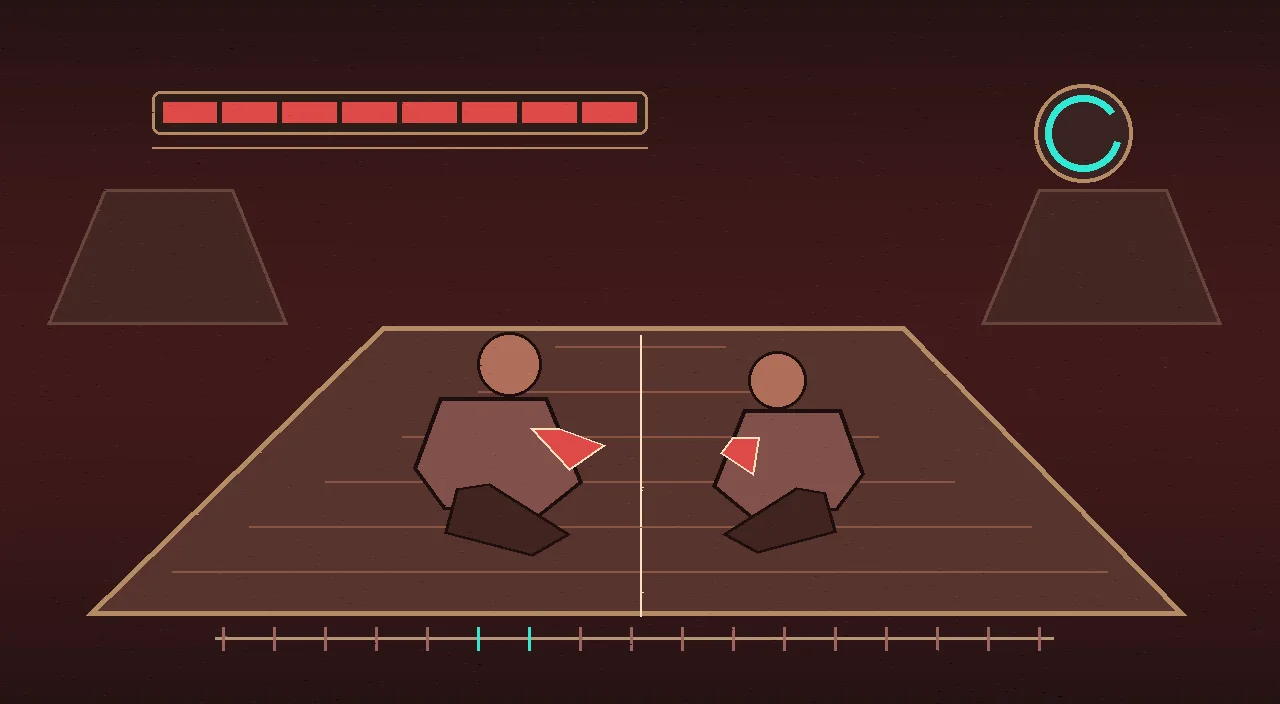
A room around two state markers
The Spent Escape takes place in the fictional Ember Ledger arena. A stylized character holds a charged move in the game’s rules. The charge grows across several visible segments. An opposing character has a virtual escape token that can be available or spent. The player can watch both markers increase or change and choose when to commit an action in the simulation. This idea makes a timing question visible without asking the player to read a different interface for each character.
Let a full meter mean ready
A round begins when the virtual charge meter is empty and the opposing escape token is still available. Use the charge command to advance the meter. The game can register that the meter is ready without automatically finishing the action. Once the other character spends the escape in the simulation, the board records its new state next to the time. A second command can then commit the charged action and receive a result. The current state and historical one do not need to be shown on the same part of the strip.
The first example asks whether a player can tell the difference between a full meter and an accepted commitment. In a control case, a prepared charge is canceled before the game changes the opposing state. When a new turn arrives, the result can say the charge was prepared and later canceled. That is different from treating the original input as unregistered. In another example, both values change on the same beat, and the game step shows which one it read first. It is important to keep the result predictable even for a person who opens it directly from an end-of-round note.
The drawing follows the timing line
The arena uses dark clay, red against brass, and a narrow cyan marker. The scene needs enough room around both virtual characters for the reader to place the labels. A filled meter is separated from the result by a horizontal break. The spent token has an outlined notch that remains visible in a grayscale proof. Old time marks keep their position in the result. Active highlights can move forward without changing the explanation of a past selection.
On a compact display the two indicators can occupy consecutive rows. Put the preparation message above the available or spent status when they apply to the same decision. In the wider proof the opposing status sits beside the meter. Both versions should still have one clear place for the confirmed action. The pictures can be used with reduced motion as fixed frames whose text names the virtual states.
Current design milestone
This is a concept under development. We want to compare three short rounds with identical meter art and different escape timing. If observers can say which choice became possible after the other token was spent, the state strip is carrying its part of the design. A later test will look at the cancellation option. An understandable cancellation can allow a player to change their mind without hiding an action the system already acknowledged.
Read Full Does Not Mean Finished for the meter study. Charge Replay gives the same sort of recorded decision a slower view where the two conditions can be compared after the virtual round.