
Full Does Not Mean Finished
Back to the after-round ledger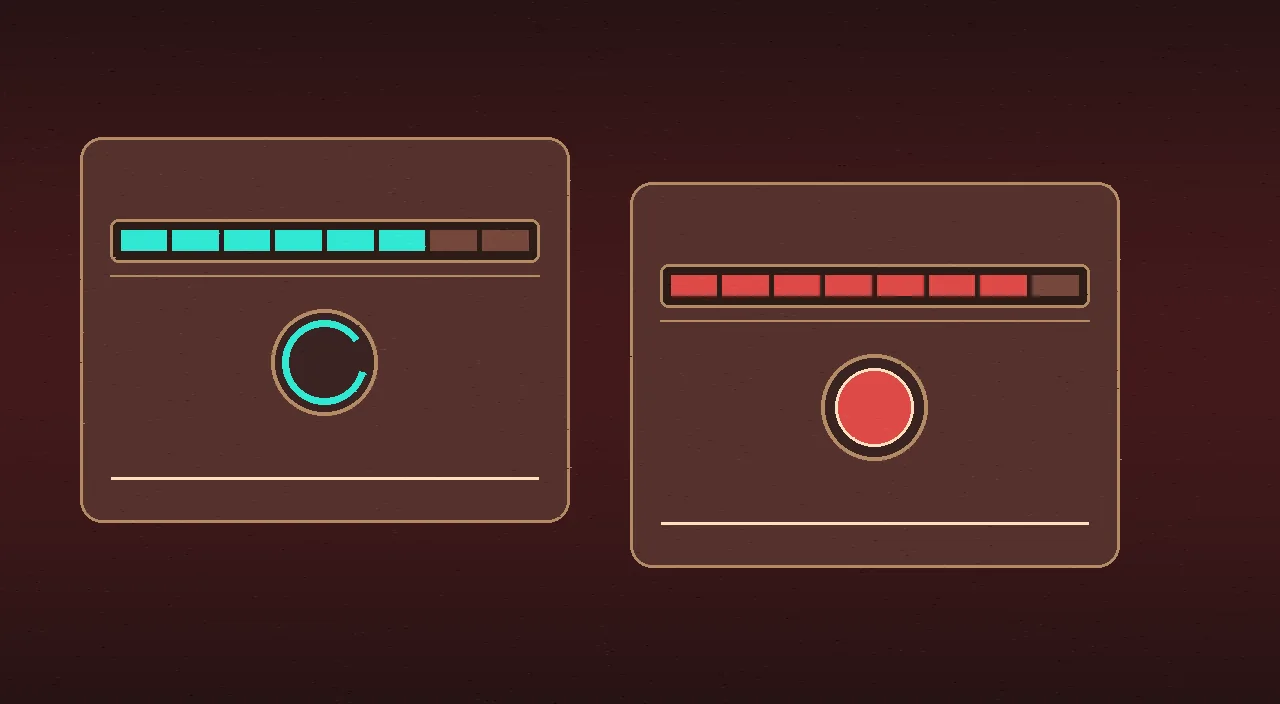
The first time we froze the meter it looked like the game had announced an outcome. The bar was full, the outline was bright, and a short click had sounded. The player had finished preparing a virtual action. The game had not received a separate command to commit it. That missing interval mattered to the prototype, and it was hard to see when the bar looked like a score stamp before the decision.
Give the meter a clear end of its own
A virtual charge fills a handful of segments on the right of the frame. Ready appears beside it when the last segment fills. The earlier label stays attached to the meter. After a person commits, a short word appears in the result area. They belong to different parts of the round. It is possible to show a full meter and an unspent choice without asking the viewer to distinguish two kinds of bright fill. Put the commitment confirmation on its own line and preserve the ready state in the replay.
The opening test uses a second marker next to the rival. It shows the state of a fictional escape option. If the opposing escape has not been spent, the game may encourage a person to hold their charged action. A confusing meter can make the choice look completed before that part of the rule comes into view. The design needs a moment when the player can see that one condition is ready and a different one is still unresolved. Put those words beside the stage rather than inside a dim background reflection.
Keep a preparation visible when no score follows
A result could report that the meter was filled, the charge was held, and no action was accepted before the next beat. That gives a reader more than a missing point or an unexplained reset. The record belongs to the original round and will be readable when another board starts. If the player chooses cancel, store a separate indicator which preserves the prepared mark as a historical condition. The decision to withdraw can then be read against the recorded time rather than looking like the charge never finished.
At small width the result can stack below the active state. We need to check the line break. A long explanation should not wrap in a way that separates the condition word from the mark it describes. The width of a phone proof is a better place to try real phrasing than a wide temporary canvas. Someone may also read the summary without the scene. A title such as the previously recorded condition can identify what belongs to the old turn.
Compare three endings without sound
Our planned review uses one case that finishes preparation and stops. In the second, the move was confirmed immediately. The third delays it until the opposing state changes. Ask a reader which entries received a score and why. Show the same three endings without sound or colored highlights. A meter can keep its visual interest. Its role is to show preparation, without also answering whether the game counted an action. If a viewer still confuses those moments, look for a word or edge that can differentiate them before changing the timing.
A follow-up can reduce the number of meter segments and see if the category distinction survives. The viewer should not have to memorize the exact number of lit divisions. A ready tag can provide the same fact. This gives us room to vary pacing later without making visual literacy depend on tracking every small increment. In the short prototype, keeping the available command near the status is more valuable than making the meter flash.
The Spent Escape gives the full context, and Leave a Cancel Mark follows a separate outcome that reuses the preparation display. Both treat the meter as part of an invented game and keep every marked state attached to its own round.